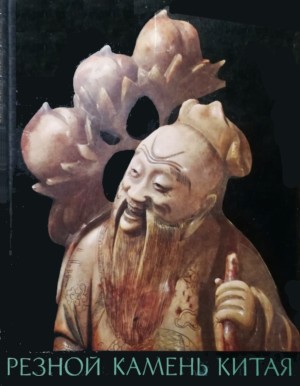
 М.Н. Кречетова
Резной камень Китая в Эрмитаже.
// Л.: Изд-во Гос. Эрмитажа. 1960. 104 с.
[ M.N. Kretchetova, Carved Stone of China at The Hermitage ]
[Plates]
The art of stone-carving — one of the most original branches of Chinese applied art — had been practised already in the earliest times of Chinese antiquity. Being developed through all the history of China and following the style of different periods, it reveals the Chinese lapidaries’ special gift of showing to the best advantage the peculiar qualities of the stone as well as the specific way of its treatment. The art of Chinese stone-carvers has been showing their keen perception of the world surrounding them and the versatile ways they find to represent it in stone.
“Jü shih” is a general term employed to denote jasper, nephrite, and jadeite which is similar to the latter in colouring. Alongside with these stones Chinese lapidaries use agate, several species of chalcedony, rock-crystal, amethyst, and some other kinds of stone attracting the lapidaries by the variety of colours, by hardness, and resonant quality. The main role among them is played by nephrite of which the primitive man availed himself in shaping his implements and weapons. In the period when bronze, and later — iron, had already been used, nephrite was applied in carvings of a variety of objects, such as sceptres and tablets, which served as marks of distinction, various religious emblems, vessels, and disks with circular perforation (“pi”), girdle-and head-dress ornaments, as well as other small articles of everyday use. Among the latter, great interest present toilet-boxes and oval cups of the form which is frequent in Iacqer wares beginning with V c. B.C. Recent excavations carried out by Chinese archaeologists gave examples of finest objects, made of nephrite and jasper, testifying to the high level of the art of stone carving in China of II-I millennium B.C. It is not mere chance therefore, that in Chinese literature jewels are often mentioned as constantly decorating the garments of the nobles. In particular, the ancient Book of Songs, “Shi king”, mentions jasper and jade ware as highly valued in China. Jade is also frequently spoken about in the literary docu-
(16/17)
ments of later periods of time. Many beautiful legends were bound up with this stone. A magic power — to prevent poisoning, was ascribed to it. It was considered a reliable remedy. The Imperial treasury consisted to a considerable extent of jade and jasper; if they lacked, it meant the treasury was exhausted. Therefore it is natural that already in the times of antiquity there existed court workshops where most skilled lapidaries worked for the Imperial court and the nobles. The stone carvers had always been distinguished among all the artisans of China and enjoyed the greatest privileges.
With time objects in stone became accessible not only to the restricted circle of the nobility. Numerous workshops began to supply the foreign and home market with their production, thus making Chinese stone carvings — alongside with silk fabrics — world famous.
The main source of getting nephrite employed by the Chinese were long seams of jade in the mountains of Kwen-lun near Khotan, (Yü tien), the biggest oasis of Sinkiang, which lay on the “Great silk way from China to the West”. Nephrite was a matter of particular importance in the trade from Khotan to China. By the order of the Chinese rulers unwrought pieces of jade by thousands of pounds were brought from Khotan to China. It was also brought from Yarkand however not on so large a scale. Chinese literary documents mention the quarries of Lan-t’ien (the Province of Shensi) as well as some other localities of jade in China. All they, however, were exclusively of local importance.
From XVII century on jadeite, which differs from nephrite by its bright, light-green colour, is brought to China from Burma. For many years Burmese localities of jadeite become the source of getting jadeite for China. From the same period of time some other minerals such as agate, chalcedony, rock-crystal are used in stone carving. With the exception of the very soft agalmatolite, “ch’in t’ien”, (called also soapstone or steatite), and turquoise all the other materials employed by Chinese lapidaries are of exceptional hardness, which requires great persistence and skill from the artists. 1 [1]
The technique of stone carving in China is very simple. The tools, though numerous, are not elaborate and did nor change much with time, which makes it very difficult to date the stone carvings. A considerable advance in the process of working the hard stones has been shown since a rotating metal disk was put in operation; this not only made the lapidaries’ labour easier but gave them possibility to execute some parallel work, as well as promoted the use of new instruments which gradually supplanted the old primitive ones. The Chinese lapidary works up to now by hand. His machine-tool is supplied by two treadles connected by a ropedrive with a revolving spindle to which is fastened a metal disk with sharp edge (circular saw) (Fig. 1). This saw is used for roughly preparing the pebble and cutting it into pieces.
The use of an abrasive mixture of sand and water was indispensable condition of the process of grinding and polishing, etc. There are several kinds of sands: “yellow sand” of crushed quartz (hardness 7); “red sand” of crushed almandine garnets (hardness 7,5); 2 [2] “black sand” of crushed black corundum (hardness 9); 3 [3] carborundum — “black or Canton sand” (hardness 9,5). The abrasive mixture was usually held in a vessel placed under the disk of the machine-tool. The disk revolving, wet sand stuck to it thus intensifying friction and furthering the very process of cutting. Pao-yao (crushed corundum diluted by lime sediment) gave the final polish. Diamond (hardness 10), usually fixed at the point of the tool, is up to now employed to engrave inscriptions.
(17/18)
The pebble being cut into pieces, the lapidary outlines his future work. If the piece of stone is large it is fixed at the machine-tool, whereas small pieces of stone are held by hand in the process of work.
Having thoroughly studied the markings and form of the mineral the lapidary outlines the design in indian ink on the wet surface of the stone. From this moment on he begins his strenuous, laborious work which he carries out by means of successive change of metal tools attached to the disk. The most difficult is the process of taking out the core of the vessel. A hollow tube is carefully driven into the depth of it, just so as to cover the core, which is afterwards taken out with the help of a point-tool and a small hammer.
The lapidary has at his disposal a variety of small tools applied in conformity with the character and size of the design. In openwork carving the perforations are made by means of a diamond borer and afterwards worked by a steel wire the ends of which are fixed at a pivot (bucksaw). Abrasive mixtures are used through all the stages of work. The final polish is done by a wooden wheel covered with leather, and by “yellow” (diamond) powder or paste including one of the coloured “sands”.
A Chinese lapidary may always be recognized by the way he treats the material. In the West the stone is valued chiefly for its even colouring and transparency; they usually work it by cutting to make the stone dazzle. In Russia, stone carvers make good use of the natural colouring of the stone at the same time making it subordinate to strict forms of the piece, with architectonic principles always prevailing. They often combine stone with metal, mostly with bronze. The Chinese lapidary is attracted by peculiar markings of the stone, by its innate form, which inspire him in the creation of his always surprising compositions. That’s why he for a long time studies the form of the stone and the character of its veins trying to make use of each spot or streak. He often has to give up his initial scheme for it is only in the process of work that he can determine the form of the spot or discover an unexpected cavity. The peculiarity of the material always keeps strained the lapidary’s creative thought, making it often necessary to change on the spot the composition he outlined.
The Hermitage collection numbers about a thousand pieces of Chinese objects in stone. It was formed little by little in the course of two and a half centuries, being commenced by the acquisitions made by the Russian Czars and the nobles. Considerable additions were made in the post-revolutionary period, when the best works of art held in private collections were put under the control of the State museums.
By richness and variety of material the Hermitage collection is une quailed in the U.S.S.R. and makes it possible to trace the main stages in the history of stone carving in China from I century A.D.
The earliest examples of stone carvings are fragments from pale-green nephrite plaques (probably symbols of the power of a ruler), excavated by P.K. Koslov in Noin-Ula and dating from I century B.C. They did not retain the whole of the original form. Of special interest are thin parallel lines relieved against the surface of the plaques. These are marks left in the process of cutting the stone, which gives the opportunity to find out the ancient method of work.
The finds made by A.P. Okladnikov in excavations at Ivolgino ancient stronghold, near Ulhan-Ude, namely an oval cup of grey stone (limestone), are believed to date from the Han period (III century B.C. — III century A.D.). The cup is similar to those made of lacquer in V-III century B.C., found by Chinese archaelogists [archaeologists] in the region of Changsha, Hunan Province and by P.K. Koslov in Noin-Ula. Together with it there were found some nephrite rings which may have served as buckles for a belt or neck-strap of the armour, and which may be compared to a ring shown on the armour of a terra-cotta statuette of a warrior from a burial of the T’ang period (VII-X century).
(18/19)
T’ang stone carvings are lacking in the collection of the Hermitage. We may get an idea of some types of Sung carvings (X-XII century) from several later pieces reproducing those nephrite vessels of the Sung period which are recorded in old Chinese catalogues and publications of foreign collections. Two pieces represent the stone carvings of the Ming dynasty (XIV-XVII century): a green nephrite figure of a recumbent buffalo, and a fragment from a marble relief representing the head of a Buddhist saint.
In spite of the small size the figure of a buffalo produces the impression of monumental dignity, suggested by the generalized forms of the recumbent animal. The surface of the stone, though somewhat damaged in the course of time, still keeps its beautiful polish. The muscles are but outlined and nevertheless the figure of a sluggish animal is rendered with great force of expression.
The head of a Buddhist saint is a work of the Ming period repeating a traditional image originating in the Buddhist iconography of the T’ang period (VII-IX century). It is somewhat dry in the manner of execution if compared with the earlier works of this type; however, the sculptor gave life to it showing his face in three-quarters, the head slightly down, his eyes half closed.
The rest of the material in the Hermitage collection belongs to a later time covering the period from the seventeenth to the twentieth century. Alongside with purely ornamental pieces such as table-decorations, this part of the collection possesses things of everyday use: bowles, goblets, toilet-boxes, scent bottles, and vases. A considerable place is taken by materials used in writing and painting: vessels to triturate indian ink, water droppers, and brush pots. Pendants, beeds, earrings, necklaces, smoke-pipes and snuff-boxes belong chiefly to XIX-XX century.
One of the two main trends in Chinese stone carving beginning with XVII century is characterised by imitating the forms of the old bronzes. Both nephrite and bronze ancient vessels being used in religious worship, they became similar in form and ornament. Both originated in religious performances and were of highly symbolic significance. Having lost with time their symbolic sense they for many centuries still remained a rich basis for the applied art of China. Forms and patterns of the old bronzes popular in Chinese carvings from the ancient times are copied over and over again till the present day.
Stone requiring a specific method of working it, forms and ornaments originally typical of metal-work ought to be changed, which resulted in appearance of new types of objects made in accordance with the art and fashion of the new period. The Hermitage collection possesses some vessels keeping closely to the classical “bronze” forms. Two of them, one of green nephrite, another of lapis-lazuli, are of the “tui” type (the “tui”, a bowl for sacrificial cereals in I millennium B.C.). Both are decorated with t’ao-tieh mask, which in the times of antiquity was to symbolize the powers of the universe. Some grey and green nephrite vessels made in XVII-XVIII century with no less skill reproduce the ancient type of the “ku” vessel used in II millennium B.C. for sacrificial wine. The “ku” model is here recognized by free treatment of the meander and other ancient ornaments of the ciceda and “t’ao tieh” type.
It often happens that forms and ornaments characteristic of different periods are combined in one piece; the Hermitage vessel of green nephrite with bright-yellow spots is an example of this case. Its form imitates the ancient “ku” type, whereas the sculptural figurines of lizard-dragons decorating it appear not earlier than on the bronze vessels of V-VII century B.C. The combination of these decorative motives makes it possible to classify this vessel as one of the group of XVII-XVIII century objects exhibiting a most successful use of ancient traditions of Chinese art.
(19/20)
Handles in shape of animal head, with loose rings, first appeared in old bronzes. Stone carvers imitated them in spite of the difficulties in carving the loose rings. A number of vessels in the Hermitage collection, though differing in style, are supplied with such type of handles. Exceptional virtuosity is shown by the lapidary in his carving of small flagon and stone chain made of the same piece of jadeite.
The Hermitage collection presents many interesting examples testifying to the great variety of XVII-XVIII century stone carvings combining old and new traditions of art.
Of exceptional harmony and peculiarity of form is a thin-walled vessel with milky-white nephrite cover dating from XVII-XVIII century. It shows to the best advantage the lapidary’s high artistic taste revealed in his way of treatment of old archaic motives. Figures of coiling up dragons decorate the cover, the handles are supplied with loose rings, the “bronze” ornament carefully carved in low relief covers the body.
Remarkable for its composition is a greenish nephrite vase decorated with two phoenixes relieved against the shoulders of the vase. Their wings embracing the vase leave some place for clouds-ornament carved in low relief.
Of more monumental character is a dark-green nephrite vase with handles shaped in the form of an elephant’s head, with a ring in his trunk. A relief ornament entirely covering the vase and forming the chief means of decoration, is somewhat similar to the ribbon-like patterns of Chinese silk fabrics of the Han period (III century B.C. — III century A.D.). Both in form and proportions the above mentioned vases are typical of Ch’ien-lung period (1736-1795). The like type of vases was produced in porcelain and metal; being often dated they become a sure means of identifying the date of the stone vases.
To the same period belongs a vase of most peculiar form worked into the shape of a double cup decorated with figures of bats, two of them serving as handles, the other two connecting by their wings both parts of the vase.
Much interest present stone cups wrought into various shapes by skilled lapidaries. In case the form is simple they take advantage of the beautiful colouring of the stone. The Hermitage collection possesses a chequered cup of strict form remarkable for the natural colouring of the bluish-grey chalcedony; it is supplied with rectangular handles decorated with dragons climbing on to the rim of the cup.
Alongside with the trend which keeps closely to the old traditional forms of bronze types there exists another style of stone carving characterized by the artist’s tendency to use the peculiarities of the material. The lapidary skilfully makes the stone obey his hand, his artistic conception being, as a rule, based on careful treatment and keen observation of nature.
Chinese lapidaries are always attracted by the variety of forms appearing in Nature, a fact well shown in the carvings of floral motives. Simple and unaffected are their carvings of tree, or rock, stump, or branch laden with blossoms, or fruit, each object having at the same time some utilitarian purpose. The Hermitage collection is most representative of this kind of stone carvings.
A three-coloured chalcedony vase is one of the most perfect creations of this type. It is shaped as a stump of an old peach-tree with young sprouts laden with bright-red fruit emblematical of long life. The lapidary makes here brilliant use of bright red, white, and grey markings of the stone.
The same sort of stone is employed in carving of a table decoration representing a group of fantastic fungi, “chih”, which according to popular mythology are to symbolize longevity. They are very ornamental and at the same time carved in forms surprisingly true to nature.
A variety of other specimens cut in different stones may be mentioned, e.g., a greenish nephrite brush-pot in shape of a cabbage-head, or dark amethyst carving of two magnolia
(20/21)
flowers, or white nephrite carving of a fruit called “Buddha’s hand”, etc. These and many other floral forms seem to obtain life under the lapidary’s tool. Various and always beautiful in form are tiny cups shaped as a flower or fruit of a peech-tree, or as a pomegrante entwined with a branch, the blossoms and leaves forming the foot of the cup.
Lily flower and buds (greenish nephrite) and peash-fruit on a twig with oblong leaves (even-coloured dark-green nephrite) are executed in strict, generalized forms. Apart from skilful work they display the exquisite taste of the stone carvers who made them. The impression is intensified by the lines from the poem by Tung Fang-shou, a poet of the Han period, running around the rim of the peach-shaped vase: “[in] three thousand years the flowers bloom, [in] three thousand years the ovary forms, [in] three thousand years ripen the fruits, [in] three thousand years [they] become nephrite.”
A vase of white translucent stone (marble) in form of a piece of bamboo belongs to the same group of objects.
Sceptres of Good Fortune 1 [4] being widely used by the upper classes in China, they had been wrought in a variety of materials. Among those of the Hermitage collection, two rank especially high: the one is shaped as “chih fungi”, the other — as a branch of pomegranate-tree, both made of green nephrite.
One of the favourite subjects appearing in stone carving is representation of children. A wish of numerous progeny was from the ancient days typical of the symbolics of benevolence and steadily keeps in Chinese art up to now. A tiny vase in form of a pomegranate supported by two boys’ figures must be regarded as expressing just this idea.
We may come across still more complicated symbols of benevolence based on popular mythology. Such is a well-known legend about Liu Hai-êrh and the three-legged toad suggesting hope of profusion and good fortune. Two episodes of this legend are shown in the carvings on a nephrite vase in the Hermitage collection.
Most expressive are carvings representing philosophers, scientists, and Thaoist saints, executed mainly in soft stones (agalmatolite or steatite). These images show the artists’ close study of the human character and passions.
Groups and single statuettes of different animals and mythological characters are executed with the same keenness of observation and are most inventive in compositional design. A buffalo with a boy on its back carved both in nephrite and in rock-cristal, nephrite carving of a group of goats, a pair of ducks, emblems of faithfulness, a leaping stag whose antlers are set off by the red colouring of the two-layered chalcedony — all they display the infinite variety of natural forms so truly shown by Chinese lapidaries.
They sometimes shape a musical instrument in the form of an animal, a fact well shown in the cutting of a small aventurine gong having the form of a bat.
There are also fanciful animal forms. The Hermitage collection possesses numerous representations of dragons; deity symbolic of rain in ancient times, the dragon became emblem of imperial power in later periods. Special interest present carvings of dragons amid the waves decorating a big greenish nephrite vase, their movement following the form of the vase. Often there appears a representation of ch’i-lin, a dragon-like creature with one or two horns, believed to be a home guard. Figurine of Budda’s lion, carved in various stones, traditionally serves as a head of a seal.
All the pieces mentioned above, though different in subject and manner of execution, testify to the fact that Chinese art of stone carving flourished towards XVII-XVIII century, which coincided with the renaissance of all the branches of applied art under Kang-hsi (1662-
(21/22)
1722) and Ch’ien-lung (1736-1795). In that period many stone-masonries became active, first of all those working for the court and supplied with materials of superior quality. The work made to order of the emperor and his court being various and complicated, it put heightened requirements towards the artistic quality of the lapidaries’ production. At the same time considerable improvement in technics made it possible to master a most fine carving. The use of a tool with a diamond point permitted to execute, even in stone, most tiny inscriptions and engraved designs. Special liking for engravings on stone typical of the period under notice, was due to the strong influence of Chinese engravings, which could be traced in painting on porcelain too.
At the end of XVIII century Chinese lapidaries concentrated more and more on technical problems at the expense of general artistic conception, a fact contributing to a gradual decay in Chinese art of stone carving which became especially distinct in XIX century.
Some specimens kept at the Hermitage and bearing the mark of the court workshops of Ch’ien-lung period testify to the lapidaries’ concentrating most on the perfection of execution. These stone carvings are decorated with traditionally repeating landscapes and dragons, appearing also in bone-and wood carving. The “Swallow Cape” rock on the Yangtze river is carved of a block of greenish nephrite. The peculiarity of the natural form of the stone is used by the lapidary to show a vista formed by the city wall, some buildings and a picturesque group of trees. At the foot of the rock some boats are shown. On the back side of the rock there may be seen two engraved poems by Ch’ien-lung bearing the dates 1765 and 1775. The delicate and refined manner of execution the inscription is to a certain degree not in tune with the generalized and somewhat dry style of the whole work.
Still more perfect is the engraving of the inscription presented in an Imperial seal carved of a rare sort of bluish nephrite with black spots. The seal has a form of a truncated pyramid placed on a cube and surmounted with a traditional figure of a two-headed dragon. The sides of the seal are engraved with the tiniest hieroglyphs, gilded, presenting the name of Ch’ien-lung and the date — 1780. To the same type of stone carvings belongs a table-screen composed of three nephrite plates enclosed in an ebony frame engraved on both sides with a fine design representing dragons amidst waves, and a landscape. A mountain landscape is engraved in thin outline on one side of the stone plates. An explanatory text on the back side of the screen gives the name of the locality (Lung ching) as well as some facts about economic importance of the area. The screen bears no mark or inscription suggesting the date, however its subject and the presence of the explanatory text, as well as the manner of execution allow to regard it as one of the most typical works dating from the end of Ch’ien-lung government. Though it is a piece of fine craftmanship, it is dry in the manner of execution, stone being used as material for engraved design and inscription which do not require volumetric treatment.
Such a way of using stone restrained the lapidary’s creative power and contributed to the appearance of works deprived of originality and ingenuousness.
From the end of Ch’ien-lung period Chinese carvings tend more and more to fine openworked ornaments, frequently applied in carvings of stone plaques worn by women. These thin jade plaques had been pierced all over with fine floral and geometrical patterns, often combined with hieroglyphs emblematical of benevolence which are sometimes encircled by bats. Used as girdle-pendants, the plaques produced melodic tinkling, as the wearer moved, which according to popular belief was said to keep off evil spirits. To the same group of objects belong tiny receptacles for dry scents presenting two halves of a box joined by a silk lace which was also used to attach the box to the belt. A small openworked vase with ring-handles is set with rubies. It, possibly, was intended for export to Iran or India where such combination of different stones, alien to Chinese taste, was often applied.
(22/23)
The nineteenth-century stone carvings repeat all the types formed in the previous periods. The images become more ruff; they often lack that freedom of composition and keenness of observation which were so typical of the carvings of XVII-XVIII centuries. The Hermitage collection possesses a vase shaped in the form of magnolia flowers and carved of snow-white marble which gives the opportunity to emphasize the texture of the fleshy petals. The tall foot is composed of twigs and leaves, carried out in a dry, lifeless manner. It is possible to give many other examples showing the lowering of the artistic value of many carvings, in spite of the fact that the lapidary uses most valuable stones of beautiful markings. The same features are characteristic of the nineteenth-century stone carvings imitating the old bronze types. Proportions of these objects in stone are not always at their best, the carvings often lack strictness of form, old types of ornaments, long deprived of their symbolic sense, are sometimes too freely used.
From the end of XIX century some workshops start producing a number of small pieces of rather low artistic value both, in material and, especially, in the manner of execution. They were made of small pieces of jade, chalcedony and other stones, which was due to the lowering import of stone, the trade with Khotan and Yarkand being broken off in 1865.
The workshops of Soochow, Province of Kiangsu, once prosperous, almost ceased to exist. By the beginning of XX century part of the workshops was moved to Shanghai. Peking, Shanghai and Canton became chief centres of stone carving manufacture. The workshops differed as to the amount of work and the way the work was organized. They contained from 3-4 to 12 lapidaries. Small workshops produced the finest work. Sometimes the process of working out the stone was divided among several workshops: the one carried out the process of carving, the other — of polishing the stone. Some workshops were specialized either according to the use of certain stones, or according to the type of things they produced. This process was especially typical of the end of XIX century and XX century and was due to the increase of production of low artistic value.
Nowadays, in the People’s Republic of China, the Government and the Kommunist Party pay the greatest attention to the development of all the branches of applied art, namely of the art of stone carving. Arrangements were made for improving the conditions of work, the encouragement of popular art of stone carving being the matter of special care. Vast art-exhibitions organized in Peking, made it possible to single out the most gifted lapidaries, who, often, practised stone carving only as a by-work. Among these a talented lapidary P’ang Yü-ch’en may be mentioned. Formerly an amateur-carver he now became teacher of the Central Art Institute. These artists concentrate more and more on subjects showing new life of the free people of China. Episodes of the people’s war of liberation and its heroes are subjects treated by Chinese lapidaries with as great care and love as those showing new life in the city and in the village.
Nowadays the most outstanding carvings worked in different stones are produced in Peking and Shanghai. Hundreds of artists working in the Province of Che-chiang, (regions Wen-chow and Ch’in-t’ien) rich in soft stone, such as agalmatolite (steatite), skilfully use the natural colouring of the stone in their productions.
Contemporary Peking and Shanghai stone carvings made in nephrite, jadeite, agate, chalcedony, rock-crystal and other stones, show that the lapidaries carefully follow the old traditions of Chinese art. Forms and ornaments of ancient bronze vessels are often used. The Hermitage collection possesses a rock-crystal vase with ring-handles and a cover surmounted with a figure of a lion. In shape it reminds an ancient bronze vessel. Perfect work and feeling of proportions testify to the great skill of Chinese lapidaries of to-day. Thanks to the gifts made by the Government of the People’s Republic of China, all the chief branches of Chinese contemporary art of stone carving are represented at the Hermitage.
(23/24)
Alongside with new subjects and reinterpretation of ancient most cherished forms and patterns, which passed through all the history of Chinese art, modern lapidaries exhibit their keen understanding of nature shown in their fine carvings of flowers and birds. The most representative piece of this style is a coral vase decorated with birds and flowers.
Contemporary production of Chinese lapidaries shows that the people of China did not forget the high traditions and achievements of the past. Making good use of the cultural legacy of the past, the art of stone carving successfully develops under new conditions brought to the people of China by the liberation of the country.
[1] 1 The hardness of nephrite varies from 5,5 to 6; that of jadeite from 6,5 to 7; that of rock-crystal from 7 to 7,5.
[2] 2 Out of use in contemporary stone carving. Formerly served for cutting turquoise and other soft stones.
[3] 3 The hardest mineral with the exception of diamond. Used up to now.
[4] 1 Ju-i, “as you desire”, “according to your wish”.
наверх
|